How I’ve benefited from Mindful Eating

Hello Readers! I hope that everyone had a fabulous week! I know I did but that might have something to do with the fact that I spent it in Jamaica on my honeymoon… Not bragging… ok I am. Both Adam and I had the best time ever in Montego Bay and were able to spend some quality time resting and relaxing and enjoying each other’s company.  Ok, as much as I know you would all love to hear more about my honeymoon, I’ll get on with today’s post!

I talked last time about some easy ways that you could start to eat more mindfully.  Even if you incorporate one or two of those techniques into your eating habits, you can start to reap the benefits of mindful eating.  But what exactly are the benefits to mindful eating?  Why should you care about the way you eat?  Glad you asked and happy to answer!  Now keep in mind, this is the way that I personally have benefited from mindful eating.  While it will probably be similar, you may experience different results.  That is totally cool, because we are all different!

1) More aware of the food that I eat By slowing myself down and really taking the time to consider the food that I am about to eat I have noticed that I am able to really see how different foods affect me.  For example, over the past few months I have noticed that whenever I eat wheat I feel bloated and my skin tends to break out.  Or when I have an egg and some type of nut butter for breakfast I am able to feel fuller for longer.  Mindful eating has really allowed me to hone my diet so that I can feel and look as good as possible.  The practice of slowing down and savoring every bit of my food has also helped to train me to tap into what my body is trying to tell me.

2) New appreciation for food Now that I try to use all of my senses while eating, I have really come to love different aspects of food.  For instance, I have come to love the sound of garlic sizzling in a cast iron skillet.  I love the smell of sweet potatoes roasting in the oven with Italian spices.  I really like the look of roasted beats next to a pile of broccoli.  While it might seem silly to feel this way about food, this has allowed me to really appreciate all the ways that healthy food nourishes my body, not just with nutrients but also with sounds, smells, and visuals.

3) Allows me to know when I’m full Before I started to eat mindfully, I could finish a meal in about 5 to 10 minutes flat if I had to.  The problem with that (besides indigestion) was that I never knew when I was truly full and would end up eating way more than my body needed in that short time frame.  Now that I take at LEAST 20 minutes to eat a meal (most of the time, longer than that) I can feel when I am approaching full.  Let me tell you, it takes a lot less food than you would think to fill you up.  Plus because I am savoring every bite, I feel much more satisfied after I am done eating.

4) Helped me to connect with others around me While this might not seem like a health benefit at first glance, it really is.  Taking the time to sit down and turn off all distractions has allowed me to connect and bond with whomever I am sharing a meal with.  Adam and I try to at least eat one meal together and sitting at the kitchen table and it has really opened up a new way to connect.  We talk about each other’s day, interesting things we read, or movies/books we are looking forward too. Some of my best memories are family meals where we all would take the time to prepare delicious foods, turn off our phones, and sit at the table and chat.  Mindful eating not only is good for the body, it is good for the relationships around you.

These are just a few of the bigger impacts that mindful eating has had on my eating habits.  There are others, such as an excitement/eagerness to create new dishes just to experience a new sensation food-wise.  Or just the simple fact that I know that I am doing something really healthy for my body and that is always a good thing!

If you have any questions or comments about mindful eating, I would really love to hear from you! Let me know how it has helped you or if you have any questions as how to get started, give me a shout! Also, check out this website for more tips and history on mindful eating.  Next week, I want to talk about how our bodies are really great at letting us know exactly what we need nutrition wise.  So have a fantastic week and I’ll see you soon!
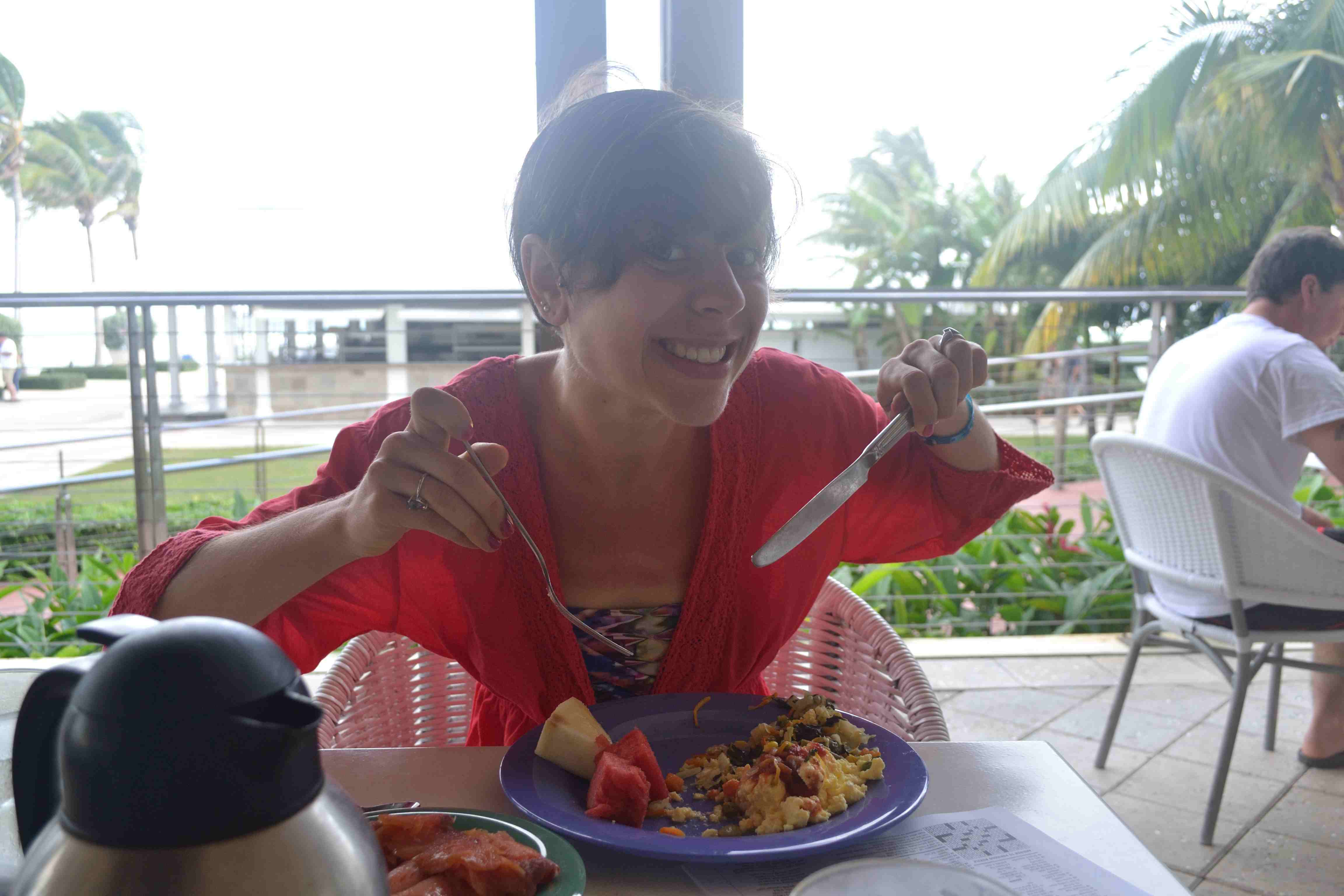
 

Such delicious food in Jamaica! I may or may have not eaten my weight in their delicious smoked salmon and callaloo...

Such delicious food in Jamaica! I may or may have not eaten my weight in their delicious smoked salmon and callaloo…

It’s the most wonderful (and busy) time of the year!

Most people fall in to two categories when it comes to the holidays.  They are either Buddy the Elf (I just love smiling. Smiling’s the best) or you are Ebenezer Scrooge (or the Grinch… your choice).  And there are a few people who fall into that middle category that are just lukewarm about all the festivities.  Sure the lights and cookies are nice but they aren’t that thrilling when you really think about it.  Me? I am Buddy the Elf to the 10th power.    I love everything that comes with Christmas.  The lights, the songs, the family, the movies and shows, the food….

Oh the food.  We all know that this time of year is when we tend to over indulge.  There are big family meals and office Christmas parties.  I already talked about the holiday overeating in a post a few weeks back so I won’t beat a dead horse.  You know that this time of year is a calorie-laden war zone, and we all handle the extra food grenades that are thrown at us in different ways.

For me, it is easiest to make healthier versions of all the food available this time of year.  In fact this weekend I made “clean” versions of eggnog and hot chocolate as well as some pumpkin bars and a loaf of ginger-cocoa bread.  They were all delicious and tasted just as fabulous as any Christmas goody.  Now, just because these are clean and healthy doesn’t mean that I can eat as much of them as I want.  Calories are still calories and you just can’t gorge yourself on healthy food and expect to not gain weight.

It is so easy to make small concessions when it comes to eating this time of year.  All those small concessions add up to one big regret later and compromised health.  In my last post I talked a little about the history of the RDA  and while I do disagree with some of the aspects of the RDA, it does have at its base a very important message.  We all need to get a certain amount of nutrients, vitamins, and minerals.  While it might not be the same amount or the same type for every person, it is vital that you fuel your body properly.  It will help especially this time of year when temptations are lurking behind every Christmas tree.  A well fed body will function better and be able to handle all those little temptations.  When your body has all the proper nutrients, it is more satisfied and less likely to gorge Christmas treats!

In the next posts I am going to break down the different parts of the RDA and help you sort through what you need to know to feed your body properly!  In the mean time enjoy your holidays and don’t fret over every single piece of food that you eat this season.  A few cookies will NOT kill you!

Our first married Christmas tree! SO PRETTY!!

Our first married Christmas tree! SO PRETTY!!

You’ve got the power!

What do you think of when I say willpower? Maybe resisting temptation, overcoming adversity, or maybe a specific person comes to mind.  Whatever the case, some form of strength comes into play, the word power is right there.  A lot of you may believe that you have absolutely no willpower, especially when it comes to food.  When you see that plate of cookies you know you are going to cave and have one, or six.  What gives a person willpower? Why does it seem like some people have greater amounts of it? How do you tap into that?

Willpower is a tricky thing.  You can’t see it, only its effects.  Willpower also means different things to different people so it is hard to give it an exact definition.  But I do believe that we all have willpower, no matter how weak you might think yours is.  I think there are a few important aspects to a strong willpower that makes it seem as if some people have great stores of it while others are just trying to muster up a few drops of it.

The first one is the desire to change.  It might seem obvious, but this is so often overlooked or not given much credit.  People have a strong willpower really and truly WANT to change some aspect of their life.  Let’s take nutrition and eating (this is a nutrition blog after all folks).  If you really want to eat better you have already taken the first step to having more willpower.  But Katie, I do really want to eat better, I just can’t resist those “bad” foods.  Then no, you don’t want to eat better, you want to eat the same garbage you have always eaten.  Sorry to be harsh, but saying you want to change but then turning around and downing a pint of ice cream is a bit contradictory.  You almost need to be at a place where you are disgusted with the way you are eating and the only place you can go is in the total opposite direction.  There is a point where you will WANT change and act on that want, there is the first little hint of your willpower.

The second part of willpower is motivation.  Wanting to change your eating habits is great but you are going to have to have motivation to keep that change going and to strengthen your willpower even more.  Motivation is another tricky idea; here is the technical definition of it.  I’m going to simplify it because I think that it doesn’t need to be super technical. Motivation is personal to you and is what gets you revved up and going.  What motivates me probably will not motivate you in the least.  That’s fine, what isn’t fine is when people use what they are fighting against as motivation.  Let’s use eating again. If you are trying to eat better and maybe lose weight and decide to motivate yourself by promising yourself a piece of chocolate cake if you lose five pounds, how is that helpful? That’s the equivalent to trying to quit smoking and rewarding a smoke free week with a cigarette.  Find other means of motivation for what it is you are trying to change.  By using food to reward yourself, you’re just slowly weakening your willpower as well as your motivation to keep going.

One other thing that is important to willpower is the perception of gaining something from your use of willpower.  In this article, the author talks about how when people see results from the use of their willpower, it actually gets stronger.  That makes a lot of sense; if you see the fruits of your labor, aka willpower, you are going to continue to use it.  And as a result of continuing to use your resolve, you’re strengthening it.  And that right there will motivate you to keep up your change (see how it’s all tying together!?).

I can’t tell you how to get willpower.  It’s not as simple as that.  I can tell you that you already have the willpower you need to change right inside yourself.  You just need to find it.  You have to truly want that change, and you will need to find the proper motivation to keep going.  Take a look at your life and see where your weakest area is.  Ask yourself if you are ready to take on the job of turning that behavior around.  If you are then you have the tools within to make that change. I believe in you, do you?

It’s ok, I workout

That phrase is one of my biggest pet peeves when it comes to diet and health.  Sadly, this attitude is becoming more and more prominent and it is a very slippery slope towards poor health.  Just within this past week I have heard those words in passing at least twice and I know numerous others who have adopted this mindset.  I will admit that I have fallen victim to this way of thinking a few times. It’s so easy to justify certain things when you work hard, but in the long run it will just pull you right back down the way you came.

There is no sugar coating the truth so I will just come right out and say it, you will never out exercise a bad diet.  It’s just not going to happen.  I know it might seem totally fine at the moment.  You’re telling yourself, I am in great shape and I eat what I want!  I put in the time at the gym so I don’t have to worry about that piece of pie after dinner.  I’ll just burn it off later.  The thing is that while you might be in great shape and a healthy weight right now, that poor diet will catch up with you.  You might start to see the pounds creep back up, or worse you might find out you have a serious medical issue, like diabetes.  There has been a shocking increase in the cases of diabetes not just in the overweight but in the seemingly healthy.  This article talks about young 20-somethings who seemed to be in perfectly good health and exercised regularly but found out they had diabetes.  One thing that struck me was that they all said they might not always eat the best but they exercised regularly.  The food you put into your body is SO important.  It is the fuel that will drive you, and if it is junk fuel, you are not going to go very far and you will break down at some point.

The other fact is that most of us don’t exercise enough or at such an intense level to justify eating more food.  Most exercise sessions burn a smaller amount of calories than you think.  Eating a doughnut after a run pretty much undoes the work you just put in (this website is neat and helps you to roughly estimate the amount of calories you burn doing a certain activity).  If you have a problem with snacking, this is also really dangerous territory.  Sure, at first it might just be a bite of something.  But that can quickly turn into a small piece or am extra helping and then you’re justifying eating whole meals just because you went to Zumba two days ago.  Trust me I know how easy it is to fall into that bad habit but think of it this way: You are not a dog.  Do not reward yourself with food.

The thing is, if you are trying to be healthier and are putting in the work by logging gym time and exercising, why wouldn’t you do the same with your food?  Being healthy isn’t just taking one area and improving it, it’s an all-encompassing process.  Exercise is really important, but so is eating well and taking care of yourself.  You want to feel your best in body, mind and spirit and to do so you have to take ALL the steps to get there and not use the guise of exercise to keep a poor diet.  In the end, you’re only hurting yourself.

Late Night Munch

Admit it. You have stood in front of your fridge sometime after 9 pm looking for some snack to munch on. And more often than not you choose that hunk of chocolate cake or bag of chips over vegetables or a piece of fruit.  Snacking at night is not a new phenomenon.  It has been happening since late night TV became intriguing.  What is relatively new and starting to cause some major health problems is night eating.  While this is not a classified eating disorder yet, it is well on its way.

So what exactly is night eating? Don’t we all technically eat at night and call it dinner?  Yes, but night eating is different in the fact that those who have night eating syndrome (NES), will consume more than half their daily calorie intake after 8 pm.  Generally people who suffer from NES will eat very little in the morning and throughout the day, but once evening comes they will consume large portions of food.  Now this disorder is different from overeating because night eaters are not necessarily eating a mass amount of food all at once.  Instead, it is generally portioned out into snack-like meals throughout the night.  NES is also different from sleep eating because the person is fully awake and aware of the food they are eating.

Night eating can cause health problems in a few different areas.  First, when you eat a lot right before bed your body has a hard time focusing on getting to sleep because all of its attention is on trying to digest the food you just ate.  This can cause insomnia or at the very least unrestful sleep.  Sleep is very important to your body’s health because it is when it repairs itself and resets for the next day.  Lack of sleep also messes with your metabolism, slowing it down and causing it to not run as efficiently and therefore causing weight gain.  Unfortunately, if someone with NES has trouble sleeping they will tend to eat even more, exacerbating all issues. NES also causes problem with weight because when you consume a large amount of calories before bed or at night in general, your body doesn’t have any way to burn those calories off and a lot of them get stored as fat.  Evenings tend to be the time when most of us are at our least active.  When was the last time you decided to run 10 miles or go to a crossfit class after 9 pm? Also like a lot of other eating disorders, NES is connected with depression, anxiety, and other mood disorders. Overall, not a fun experience.

So why does night eating occur? There is no concrete answer to that question yet because there hasn’t been much research on NES.  The doctor in this article believes that people who suffer from this disorder are stressed or anxious and are eating at night as a way to self-medicate and feel better.  This doesn’t work, obviously, because it leads to health issues, and that causes more stress and anxiety.  Others believe that night eating is caused by a neurotransmitter imbalance, and while there has been some success treating NES with medication, it isn’t conclusive enough to say that is the problem.  The good news is that with a little bit of time and motivation there are steps you can take to help with night eating.  One of the first things is to make sure you are getting enough food throughout your day.  I know some people complain they just can’t eat a big meal in the morning or they don’t have time for a lunch.  That’s fine.  I’m not trying to tell you when exactly you need to eat.  Just make sure you ARE eating during the day.  Make sure you are also choosing foods that will keep you going and won’t just give you a quick burst of energy followed by a crash.  Think fiber filled foods like fruits and veggies and whole grains.  Have a plan for your dinner time and set a time for dinner and stick to it.  Again, I’m not telling you an exact optimal time to eat your dinner.  Just pick a time, like 7, and make sure you eat at that time.  After your dinner, have a night time ritual.  Create some type of routine that signals to your body you are done eating and it is time to start winding down.  Do some yoga, read a chapter in a book, watch a TV show, or have some hot tea (my favorite). Once you create a routine an stick to it, your body will learn that it is time to start getting ready for bed, not time to keep eating.

As always, if it seems like you might have NES, talk with your doctor.  They can help point you in the right direction and give you more ways to help.  I don’t want people reading this to freak out about eating at night, that’s not the point.  It is ok to snack (on healthy foods of course) at night time.  Just make sure you aren’t eating an entire three course meal before you hit the sack!