The Cost of Eating

Yes, we all know that eating healthy is good for us and eating unhealthy is bad for us.  This is not surprising news, mainly because it is drilled into our heads on a daily basis via news, twitter, blogs, newspapers, magazines… You get the idea.  So what does it cost us to eat poorly?

Health- This is the obvious cost of eating an unhealthy diet.  We all know this and it is constantly cited and analyzed.  It is also a really important factor, simply for the fact that a bad diet can cause serious complications, and may ultimately lead to death.  One of the most obvious health effects of eating an unhealthy diet is weight gain.  In 2008, 1.4 billion adults in the world were overweight, and 500 million of those were classified as obese.  There are a ton of obesity related diseases, The CDC lists coronary heart disease, stroke, high blood pressure, type 2 diabetes, cancers, such as endometrial, breast, and colon cancer, high total cholesterol or high levels of triglycerides, liver and gallbladder disease, sleep apnea and respiratory problems, degeneration of cartilage and underlying bone within a joint (osteoarthritis), reproductive health complications such as infertility, and mental health conditions, just to name a few.  That is a really long list of unpleasant complications all related to obesity.  The decision, YOUR decision, to eat unhealthy food leads to this nasty list.  YOU have more control over these issues than you might think.  In this study, researchers looked at two different measures of a quality diet and then assessed how they affected the risk of the chronic diseases mentioned above.  Both measures of a quality diet, which included more consumption of fruits and vegetables and less reliance on processed food, led to reduced risk, with the Alternate Healthy Eating index predicting risk just a little bit better.  Even small changes like eating more fruits and vegetables, like in this study, led to a lower risk of cardiovascular disease.  Food has a huge impact on so much of our daily lives, it is the fuel that runs EVERYTHING going on inside your body.  I know this comparison has been made before, but it really is a great illustration.  Think of your body as a car and the food you eat as the gas.  In order to run properly, your car needs the proper fuel, or else it’s not going anywhere and will likely have major troubles along the way.  The same goes for your body.  It needs the right fuel to function optimally.  Good food = good fuel.

Financial- There are a few factors to the financial aspect of eating a poor diet.  The first relates directly to the health factor, healthcare costs.  Let’s just look at the numbers.  In a 2009 study the CDC found that obesity related costs were around $147 billion in 2006.  By 2012, that number had risen to $190 billion, and exceeded the costs of health care costs for smoking which has in the past been the number one health cost.  That is a HUGE jump in just six years, and unfortunately it doesn’t look any better for the future.  Researchers are saying if we keep heading down the road that we are on, by 2030 health care costs will be somewhere in the $550 billion range.  I won’t speak for anyone else, but to me $550 billion feels like an astronomical price to pay for good health.  While I’m not saying this is the magic bullet to fix all problems health related, eating better foods can DRASTICALLY reduce this cost.  Instead of shelling out your hard earned money on medications and surgeries and other health costs, channel that money to a healthy diet.

“But Katie, that’s the problem!  My family can’t afford to eat healthy foods!  It’s just too expensive!”  Many people are under the impression that eating well is also synonymous with being expensive, and at a quick glance it does seem that way.  Go to the grocery store and find a bag of chips at will probably cost anywhere from 2 to 5 dollars.  If you compare that to a bag of organic chips, without added chemicals or preservatives, the price will probably go anywhere from 4 to 6 dollars.  For some families, they just can’t afford to buy all the “fancy” organic healthy food, and our family is one of them.  That doesn’t stop us from eating as well as we possibly can.  Somewhere along the line, it has gotten drilled into our heads that in order to eat well and be healthy we have to buy the top shelf, organic, non-GMO, gluten-free, dairy free, soy free, nut free, expensive products.  While I don’t think that any of those things are bad, they are NOT absolutely necessary for a healthy lifestyle.  Adam and I have a limited food budget, but we still manage to eat a very healthy and nutritious diet on that budget.  Every Friday I do one big grocery trip for the week.  Here is this week’s haul: photo

All this food cost us $46.80, which is what we usually spend on our big shopping trip.  I do also make a quick run on Wednesday’s to pick up a few things, but that is because at our local grocery store they give a 10% discount on Wednesday and that bill rarely goes over $20.  So for under $70 a week, Adam and I eat a healthy and balanced diet and there are others out there who spend even less on good food.  We have also made the decision to not eat out frequently and spend our money on whole foods that we can prepare for ourselves at home, which saves us money in the long run.  Americans are spending more and more money on eating out, which isn’t helping their wallets or waistlines.

Screen Shot 2013-03-07 at 3.50.28 PM.png

This article shows the trend of spending on food over the years, and it’s amazing to see how it has changed over the years.  More and more is being spent on quick convenient foods and then subsequently on medical costs to combat the result of eating those convenient foods.  You have the power to change that, all you have to do is make the conscious decision to spend your money on food that is healthy and not harmful to your body.

Emotional- This is one cost of a poor diet that might not be looked at as much, but it is a very important one.  Your mental health is just as important as your physical health and often the two go hand in hand.  There is an increased occurrence of self-image issues in obese individuals.  These include eating disorders such as binge eating, body dissatisfaction, poor self-esteem, and overall dissatisfaction with quality of life.  As mentioned earlier, mental disorders are also higher among overweight individuals.  So not only is eating poorly attacking our bodies, it is attacking our minds and even our sense of self worth.  In 2010, researchers conducted a study about the effect of public health advertisements on obese individuals.  Many reported that instead of helping or motivating them to be healthier, they often felt attacked and stigmatized.  So even things that the general public believes are helping spread the word about being healthier are in fact causing more stress and hurt.   Believe me I know how it feels to be unhappy about your weight or your body image.  I have struggled with self-image issues from a very early age and it is a tough thing to overcome completely.  But one of the things that is helping me everyday is the fact that I can take control of that with the way that I eat.  Again, I am in no way saying that food is the magic cure-all for every problem I have listed and not listed, but it is a very powerful aspect of our lives.

There are so many more costs that occur from the way we eat.  If I were to talk about them all, we could be here for days and while I would love to believe that you would thoroughly enjoy reading my every word on the subject (I never said I wasn’t just a tad disillusioned),  I don’t want to sit here and beat a dead horse.  Like I said at the beginning, we all have heard that eating bad is not good for us, it isn’t rocket science.  I hope that some of the information I have presented to you today has helped you see just how big of an impact the way you eat can affect your life.  I know it may seem like a huge step to totally change your eating habits, but it is worth it.  Not only to just feel better but to live better! I hope you have a fabulous Monday and talk to you guys soon! Remember to follow me on Pinterest, Twitter, and Instagram to get more updates, facts and insights into eating better!
Prep yourself before you wreck yourself

Eating healthy is too hard and too time consuming. It is so much easier to just grab some quick snack that is already made and get on with my day.

No, I haven’t gone crazy, and no it was not me who uttered those words. But I have heard every variation of this complaint when it comes to eating well. In fact I know that this is a big issue that keeps a lot of people from giving up their junk food lifestyle and eating healthy. People just don’t have time in their busy lives to sit there and prepare their own meals and snacks. While I am not diminishing all the hard working, busy people out there, I believe that everyone has enough time to prep their own food and snacks. I do it every week, and there are a ton of other bloggers out there who are just as busy as you that do it too. Check out Lindsay from The Lean Green Bean, who posts tons of pictures and recipes for her week of eating.

My point is that with a little planning and a little bit of time one or two days a week, you can make sure that you eat healthy the whole week. Sure, it does take a little effort, but I argue that the effort is well worth it in the end. Your good health counts on it! This week I am going to invite you into my kitchen and share some of the foods/tips I use to have a successful healthy week of eats for both Adam and I!

Plan it out.  My number one tip for eating better is to take a few minutes and write out your menus for the week.  I’m weird and I like to plan way ahead and have the whole week of dinners written out so I know exactly what I am making each night.  You don’t have to write out a detailed menu for every single meal for the week, but creating a general plan will help eliminate the frantic 5:30 rush to find something to put on the table.  This usually leads to throwing something unhealthy (think: frozen pizza) into the oven just to feed the hungry masses slobbering away at your kitchen door.  When you have a rough plan of your meals it makes it that much simpler come eating time.  I do my grocery shopping on Friday’s, so on Thursday I usually write out a weeks worth of dinner and then make my grocery list.  I don’t do any fancy new recipes during the week and I stick to simple dishes.  If I want to try something new I save that for my weekends when I have more time.  Some examples of a typical weeknight meal are frozen fish (tilapia, salmon), steamed veggies and brown rice.  Another favorite of Adam’s is a skillet scramble that usually consists of potatoes, eggs, beans, salsa, various spices, and anything else in the fridge that looks good.  Keep it simple and easy and that will make your nights a breeze.  No need to be a gourmet chef every night to eat well.

Pick a prep day.  Like most people I work Monday-Friday and don’t have much extra time during the week.  So I take one day over the weekend and I get as much food prep for the week done as I can.  It usually takes me only about 2 hours at the most to get what I need to get done and for some of my prep I can do two things at once.  A typical prep day will include making quinoa breakfast bars for Adam, hard cooking eggs for snacks during the week, making roasted chickpeas for lunches,  cooking brown rice or quinoa for dinner sides, cooking dried beans, and cutting up vegetables for lunches and dinners.  Simple steps like this make it so easy during the week to just grab the prepped food and be on your way.  When I first started utilizing a prep day it took me a little longer to get everything done.  But as I did it each week I got faster and more efficient at my routine and now it is just habit to get all the stuff done that I need to.  Don’t give up if it seems like you are in the kitchen forever when you first start out, once you get your rhythm the steps will fly by and you will be done before you know it!

One magic word: LEFTOVERS.  Seriously, learn to love and use leftover food.  This habit alone will make your life 10 times easier.  Plan to make a little extra food for your dinner and voila!  You have just created lunch for the next day.  Remember how I mentioned my best friend the slow cooker last week?  On the weekends I make three big crockpot meals that provide us with leftovers for the entire week.  I also make extra vegetables for dinners during the week and those also get used for lunches or as sides for another dinner.  Leftovers have been a major help in our life and keep us eating healthy at every meal!

Now that I have given you my three biggest (and in my humble opinion most helpful) hints, I thought I would share my refridgerator/freezer/pantry with you to give you some visuals on how I stock/prep for the week!

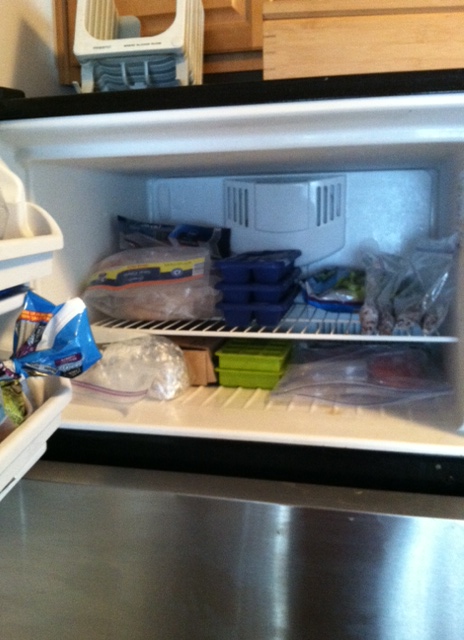
First up we have my freezer:

image (15)

I buy big bags of frozen fish (top left corner) from Aldi.  This saves money and time because it is so easy to grab a piece of tilapia or salmon, season it, put it in a baking dish, cover and bake for 20 or so minutes. Remember, you don’t need to get all fancy for your week night meals. I also have frozen veggies, that I steam for quick sides.  I also have individual bags of beans that have been cooked and frozen (top right corner).  These are so simple to throw into any dish, from soups to scrambles to salads, and they are so easy to make in your crockpot.  There are also some frozen pork chops that I make for dinner for Adam some nights (bottom left corner) and frozen homemade bread for Adam’s breakfast toast (bottom left corner).

Next up, my fridge:

image (14)Starting with the top we have a lot of eggs. We use eggs for breakfast, dinner, and snacks.  We hard cook them, scramble them, turn them into omelettes or frittatas, poach them, pretty much any way you can eat/cook an egg we have done.  Eggs are relatively cheap and they make healthy, quick meals!  Moving on down to the next shelf we have parsnips and carrots that will be used for lunches and dinners and next to that we have those beautiful leftovers I mentioned earlier!  On the bottom shelf and in the drawers we have more fruits and veggies (like broccoli, cabbage, beets, turnips, and pears) that will be used for lunches and sides for dinners. My go to method for veggies is to cut them up and then come dinner time throw them on a foil covered pan, drizzle some olive or coconut oil, season with whatever strikes my fancy, and roast them at 400 for 20-35 minutes.  Simple, quick, and delicious.  Also on the bottom shelf we have water (a must no matter what), almond milk for my breakfasts/baking purposes, veggie broth, oj, and hidden back there are some beers for Adam.  A guy’s gotta have his brew!  On the door, where you can’t really see, I have a variety of condiments such as mustard, homemade ketchup, hot sauce, salsa, jams, and other various things that can be thrown into recipes to make things taste delicious!

A quick glance at my spice cabinet:

image (17)

I’m not going to name every single spice in my cabinet, because quite frankly I am a spice junky and have probably hundreds of spices!  I have talked before about how important spices are to healthy eating because they are such a great way to season your food without adding unnecessary chemicals/calories to your meal.  Start experimenting and find out what your favorite tastes are and once you figure that out you can even start making your own spice blends, like a taco or pizza seasoning!

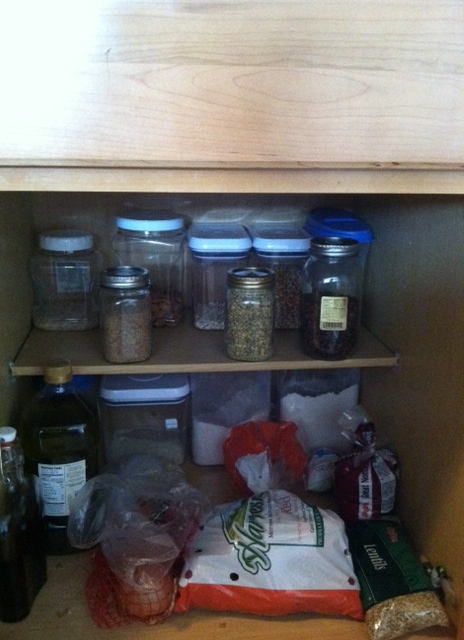
And finally my cupboard/pantry:

image (18)

image (19)In the top picture we have all my grains and flours.  I use everything from brown rice to quinoa to lentils to steel cut oats.  I also have almond flour (for gluten free baking), whole wheat flour and whole wheat pastry flour.  I also have raw almonds for snacks, onions and potatoes for meals, ground flax seed for baking, and various dried beans to be cooked.  In the bottom picture we have mostly canned goods and stockpiled stuff like soups, peanut butter (a MUST in this household), loose leaf teas and various other baking supplies.  Usually when there is a good sale on say pumpkin or diced tomatoes (fire roasted and no salt added are my favorite), I will stock up.  This makes it easy to have them on hand to throw into any meal.

Now this is by no means all the food we have in the house any given week.  We also have various other fruits and vegetables that are kept in different areas.  Hopefully the pictures helped give you an idea of how of how to stock your own kitchen and some of the tips I use gave you some ideas of how to prep your own healthy eating lifestyle.  Eating better does not have to be stressful as long as you just take some time to plan it out and stick to simple techniques.  The easy act of just cutting up some carrots for lunches or adding an extra chicken breast for dinner to make leftovers can make a world of difference in eating better! So give a few of these tips a try and see how easy and beneficial it really is!  If you already do your own prep day and have some tips/advice of your own, feel free to share with everyone!  The more we talk with each other and share our healthy ideas the easier it is to change the way we eat and live!

Have a fabulous week and I’ll see you next Monday with a post about some of the meals Adam and I eat throughout the week!

My Digestive Journey- Probiotics

Last week I talked about eliminating certain things from your diet in order to help heal your gut.  For me personally that meant getting rid of dairy as well as gluten.  This week I want to talk about adding something to your diet: probiotics.

Little Biology lesson for you:  You have bacteria and microbes all over your body, from your skin, to your eyelashes, to inside your digestive system.  Before you freak out and douse your body with sanitizer, these are good bacteria and essential to your every day functions.  These bacteria have various jobs, but the ones in your gut help to digest your food.  A healthy gut can have upwards of trillions of microbes helping to breakdown your food so you can use it to function.

When you don’t have a healthy gut, your microbe count can drop way down.  This in turn affects your digestion.  You no longer have a billion little helpers and food can sit in your digestive tract and rot or pass through only partially digested.  Clearly having rotting food sit in your gut is not an ideal situation.  This can lead to stomach problems, bloating, gas, and just general unpleasantness.  Many things contribute to unhealthy microbes.  Taking anti-biotics can damage good bacteria as well as bad bacteria, as well as eating an unhealthy diet.

This is where probiotics come in.  Adding probiotics to your diet can help restore and repair the bacteria in your gut, in turn helping your body to properly digest and use the food you eat.  There are plenty of ways to get probiotics into your diet and I’ve tried a few here on this list. REMEMBER: I’m not a doctor or any type of certified medical professional.  This is just a list that I have made based on my own research.  Talk with your health care professional if you want to start adding more of these to your life.

Probiotic Pills There are a plethora of probiotic pills out there on the market.  It can be overwhelming to try and find the right one for you.  While I’m a believer in trying to get your nutrients/vitamins/minerals from food, I realize it’s difficult to get everything you need every day from food alone. When looking for probiotics you don’t need anything fancy, just probiotics.  Here is a list, by all means not all inclusive, of different probiotics and their functions.  Start here and go through and find the function that you need and then work from there.  Look for pills that contain that strand of bacteria.  Talking to your doctor or a nutritionist can also help as they are well equipped to help you sort through all the information out there.

Some forms of dairy  This one I approach with caution.  Obviously I do not eat any dairy, but there are products, such as yogurt, that have probiotics in them..  The downside is that many times they will also have added sugar and chemicals that don’t help your digestion.  So be careful if you choose this approach.  Plain Greek yogurt is a good start and you can add in your own flavoring such as honey or fruit.

Fermented Foods Tempeh, kimchi, kombucha.  All of these are fermented food/drinks.  Because of the fermentation process, these products have probiotics that can help with digestion.  This is the route that I have been experimenting with lately and it has given me some great results.  While these foods may sound weird and not as appetizing as, say, a plate of cookies, they really taste good and are immensely helpful.  I have mentioned kombucha before and this is the fermented food that I have used the most. Kombucha is a type of fermented tea that you can purchase at most grocery stores.  Unfortunately it is pretty expensive (around $4 for us here in the Midwest  but the good news is that you can actually make your own!  I recently purchased my own kombucha kit, and while I haven’t started to grow it yet (I’m going to wait until after we move in April), it is actually a fairly simple process and not at all intimidating.  Plus once you start to grow your own kombucha you can have a never ending supply because it just continues to grow, as long as you maintain it.  Once I get kombucha down I plan to start trying to make my own fermented vegetables.  I’ll try to share that process with you as I go through it so that you can reap all the benefits of fermented food!

This is by no means a complete list of probiotic help.  There are other things such as papaya and apple cider vinegar that also have probiotic qualities and will help with your digestion.  Again, the key here is finding a method that works best for you.  Perhaps you can’t stomach the idea of eating billions of microbes (don’t worry, it is a little creepy at first) and want the convenience of a pill.  That’s totally fine, this isn’t about following the crowd and choosing what is most popular at the time. This is about finding the combination of digestive aids that works for you and gives you the best results.

Hopefully these last few posts and some of the advice have been helpful to you.  I would love to hear from you readers with any questions, comments, and/or concerns.  I write this blog to help you and your input is greatly appreciated!  Have a great Monday and an awesome week!

My Digestive Journey

When I decided to change my diet a little over a year ago, my main goal was just to have better health.  As far as I knew I had no major illnesses, I wasn’t overweight, and I had no big complaints.  I felt that I ate fairly well, but when I read about eating clean I realized that there was a lot more I could be doing for my health  I had no idea how big of an impact this switch would have on my life.

Once I cut out all processed food and focused on eating real, whole foods, I saw a lot of positive changes.  I had way more energy, my acne started clearing up, my periods were less painful (sorry men, us girls have uterus’, deal with it), my body started to become more toned, and I never felt that gross nasty “food-baby” after eating a meal.  I was ecstatic.  For the first time I felt like I had found a lifestyle that I could follow forever.  Sure, there were rough moments of temptation, and the longing for the ease of just going to a restaurant and ordering whatever.  But the positives outweighed the negatives ten-fold.

Then things changed.  After about three months of eating a whole foods diet, I started to get acne again, I was rarely pooping (yup, still like to talk about poop), and occasionally I would have horrible stomachaches after a meal.  Katie before would have ignored these problems, but new Katie refused to feel anything but her best and healthiest.

Into research mode I went.  I looked at my diet and tried to determine what could be causing my problems.  After some trial and error (and a very long and terrible night spent in the bathroom following a homemade pizza) I decided to eliminate dairy for awhile.

Within a few weeks I was back to feeling like my old/new self.  Why did I choose dairy first?  Well, like I said I did a lot of reading/research and felt that for me this was a logical first elimination.  I didn’t consume much dairy to begin with and realized a lot of my symptoms occurred after eating some form of dairy.  So out went dairy, and to be honest, I didn’t miss it as much as I thought I would.  For me, I got more satisfaction feeling amazing and healthy than I did from devouring a grilled cheese sandwich.

What does this story have to do with you?  Eliminating certain things from your diet can be one of the first steps to healing and strengthening your digestive system.  Does this mean you have to stop eating dairy to have a healthy gut?  Not necessarily.  Remember, we all have different flora/microbes in our guts, meaning we will have different nutritional needs.  For me eliminating dairy, as well as gluten, had helped put me on the path to better digestive health.

Take a look at your life and see what complaints you have about your health, whether it’s acne, achy joints, bloating or low energy.  Then start to take notice when those complaints flare up and what you have eaten prior to that.  Eliminate what may be your “trigger” food and give yourself a few weeks to test and see if your symptoms get better.  I may just be a big nerd (ok, I am TOTALLY a big nerd), but it’s fun for me to be a food detective and figure out what might be doing me more harm than good.  Don’t get frustrated if it takes awhile to pin point your problems.  Just remember you’re doing this all for a healthier you!

Next week I’m going to talk about another step I’ve taken to heal my gut.  I recently bought a kombucha tea starter and am in the process of growing (or fermenting)  my own kombucha.  I’ll share how that works and all the benefits I’m reaping from that!  Until then, have a great week and see you next Monday!

Copy, Paste… Healthy?

My past few posts have been about your digestive health.  Your nutrition and health have SO much to do with the particular microbes you have in your digestive system as well as how healthy those particular microbes are.  Many problems that people experience these days have to do with their digestive system not being in top performing mode.  The obvious solution is to take steps to fix or heal your gut, right?  The best way to do that is to follow a gut-healing diet, right? You can just find one on the internet or follow what your friend is doing, right?

WRONG! Just like your fingerprint, your digestive system is unique to you.  No one else has one that functions in the exact same way that yours does, therefore you can’t just follow a “cure-all” or “blanket” diet.  Sure, there are certain things that you can try that might be similar to someone else’s journey, like perhaps take probiotics.  But the type of probiotics your body will need will be totally different than what your neighbor’s body needs.  To really fix your gut, you are going to need to be a dedicated sleuth to your body’s functioning.  This is tough!  Who has time to constantly be monitoring how your stomach reacts to every single piece of food that they ingest?  Who wants to deal with eliminating foods (maybe foods that you REALLY like) and having a “boring” diet?  And who wants to slog through a bunch of boring research to find advice about where they should start their healing process?

I didn’t.  It was so much easier to ignore my problems or tell myself that it wasn’t such a big deal.  I wasn’t dying of a terminal illness, I could function fairly well and I was intimidated by trying to “heal” myself.  Especially since there was no way to copy someone else who had done all the work already (admit it, we’re all a little lazy).  But the more and more I read, and dealt with my not-that-bad issues, the more I realized I needed to practice what I preach.  I needed to put in the effort and work towards getting my best health. How can I keep telling you to to step it up if I won’t step it up?  Hypocrite much?  So I’ve started the task of healing myself and I want to be able to help you start yours.  While I won’t be able to tell you exactly what to do, I can offer help and suggestions.

A few things I CAN tell you are a few what not to do’s.  These were some of the pitfalls that I fell into and to be honest they are pretty easy to avoid.

Ignore. This is pretty self-explanitory, and I mentioned it earlier, but please do not just ignore what can become a serious problem.  Whether it be because you don’t want to deal with it or don’t know how to deal with it, neither are a good enough excuse for turning a blind eye to your health.  If you feel crummy, you need to FIX IT!  If only someone had shouted that at me years ago, I would have had a much easier go at this!

Be a lemming. You can not just follow the crowd on this one.  There is no band-aid that is going to fix your problem just like everyone else.  Fad diets or pills or drinks or magic potions or whatever are not going to make you better.  They might just do the opposite and wreck your digestive system even more and that is so not cool.  You obviously have to start somewhere and it is ok to see where others have started.  But remember, just because they eliminated dairy from their life and are tons better doesn’t mean that it will cure you as well.

Obsess/Worry/Stress.  Yes, this can be a daunting task.  Some of you are probably saying, “I’m not a nutritionist! I have no clue what’s going on inside me or how to fix it!”  I felt the same way too.  Take a deep breathe and focus on little changes you can make.  Don’t try to completely overhaul your diet/lifestyle overnight.  That will just cause you to freak out and that doesn’t help your problem at all. The more calm and stress free you remain, the easier it will be to stay in tune with your body and figure out what direction to take.  Take it from someone who stresses over LOTS of things, it is much easier to take it slow and save yourself the headache.

My next few posts will be about steps that I have taken to make my digestive system healthier  I think it helps to read through someone else’s journey and know that while it is different for each individual, in the end it is just about trying to get healthy so you can enjoy life to it’s fullest.  If you would like to read more about gut health and the research that is behind it I would suggest reading this article from Mark Hyman, MD, as well as this article by Dr. Elizer Ben-Joseph.  Both are really great scientific articles that can help you understand a little more about what’s going on inside your body.  I also encourage you to head over to the purely twins blog. This is a blog written by twin sisters (go figure) and they have been writing about their day to day experiences with healing their guts.  I have been following them since day one and it has been really helpful in my own journey.

Next week I will have more about my personal experience as well as some things I have done (look for a post about kombucha tea coming soon!).  Remember, this is going to be a very individual experience.  But that doesn’t mean you can’t gain strength and insight from others! I hope you have a great week and I’ll see you soon!

food for thought!

food for thought!