Clean your plate… Kind of

I am willing to bet that some of you (me included) have finished a meal even though you weren’t really hungry anymore. A lot of us have probably done this, as it’s really easy to just finish all the food on your plate even if you are already full.  You might have heard about “starving children in Africa” and felt the need to finish a second helping of french fries for their sake (because that makes a lot of sense…).  I would even go a step further and say that some of us don’t even recognize our own body’s signals for satiety, causing us to overeat at most of our meals.

This isn’t a new concept. In 2006, 6 of every 10 Americans said they ate more than they should. As a country, Americans know very well that they are overeating and that it is contributing to our ever-expanding waistlines and health problems. There have been countless studies and research that has gone into showing us that we are eating too much, but I think the more important question we need to address is when did we start overeating? I don’t mean as a nation, I mean you as an individual.

For the most part, you were not born eating too much food. In fact, if you look at children’s eating habits they are some of the best intuitive eaters. When they are hungry they will eat and when they are full they stop eating. If they don’t eat a huge lunch, they will usually eat more at dinner. They don’t obsess over certain foods or meal times. Trust me, they will let you know when they are hungry. I’ve worked as a nanny for the past two years and gotten to watch this first hand. It fascinates me how easy it is for a 2-year-old to grasp the concept of being full and being done with a meal. It doesn’t bother him if there are still five green beans left on his plate, or three graham cracker bunnies he didn’t eat. When he is done eating he is done eating and happily goes on with his day. Where did adults, the supposedly wiser and more sophisticated group, go wrong on this concept?

While there are many factors that contribute, one of the biggest influences is that of the parents, but I don’t think they are doing it on purpose.  Most parents want their child to lead a healthy and happy life.  They want to make sure that they are providing nutritious meals that will help their children grow.  It can be really frustrating and even worrisome to have a child that seems to never eat.  I know the struggle that can occur when you just want your kid to eat one bite of their meal because they haven’t eaten anything all day.  But I also believe that sometimes parents need to be open to having their child guide their own eating habits.  When parents stress over getting their children to eat, or force them to finish all their food on their plate, they could be setting their child up for future eating problems.  Over time, if a child is cleaning his plate even though he is clearly not hungry, he will begin to lose that sense of satiety.  He now knows that in order to be done with a meal, the plate needs to be empty, whether he is full or not.

Losing our sense of fullness can lead to other bad habits later on as well.  Adam shared a study with me last week about teens not paying attention to how many calories they ate in a meal.  While I am not a big supporter of religiously counting calories, it is interesting to see that most teens ignored the calorie count completely.  I don’t know if there is a definite link between being aware of how much food you eat and our sense of fullness, but I think that they probably do affect each other.  I know that there used to be many times I would be eating and I had no clue why.  I wasn’t hungry, but somehow I was downing crackers like it was my business.

How do you regain your intuitive eating skills?  It’s tough, but you can retrain your body to its childhood eating habits.  Don’t expect the change to happen overnight and don’t expect to be perfect all the time.  There will be days that you slip up and that is totally ok, just move on and do better next time.  These are a few of the tips that I use to help me really tune in to my body’s signals.

Make sure you’re actually hungry.  When you get the urge to grab a bag of chips or chow down on a huge meal, pause for just a second.  Ask yourself a few questions, when was the last time I ate?  Am I really hungry or am I bored/sad/depressed/around a bunch of other people eating?  Will I feel better about myself after eating this meal or will I look back with regret?  Once you answer those questions, you can better decide if you are actually hungry and ready to eat a meal.  To take this a step further, drink a glass of water before you eat anything.  Many times, we misread thirsty signals as hunger signals and immediately dive into a snack.

S L O W  D O W N.  When you are eating a meal, take your time.  This can be a key factor in reading your “I’m full” signal.  Sometimes we have a tendency to rush through a meal in ten minutes and not realize we had way more to eat than we really wanted or needed.  Take a few bites, put your fork down, sip some water, and enjoy the flavor of your food.  By giving your body those few extra minutes in between bites, you are letting it register the food you have already eaten and allowing you to know when you are full, before your plate is totally clean.  Also, eat until you are pleasantly full, not bursting at the seams.  No one likes that feeling of your waistband cutting in to your stomach after a huge chow fest.

Eat foods that will fill you up.  You’re probably thinking, “Uh, Katie?  Any food can fill me up.”  Let me be a bit more specific.  Choose foods that have a low density of calories, but high quantity.  Caloric-Density1

400 calories of oil, from say your fried mozzarella sticks, will not fill you up as much as 400 calories of salad.  You won’t feel full from that 400 calories of oil, so you’ll continue to eat until you do feel full, possibly taking in more food than your body really wants or needs.  I am not saying that you have to ONLY eat vegetables in order to know when you’re full.  What I am saying is that you need to choose foods that will fill you in the healthiest way.  Including vegetables in your dinner of grilled chicken and brown rice is a very easy way to add bulk that won’t bulk you up.

Be patient, and kind, with yourself.  Like I said before, it isn’t easy to retrain the way you eat or tune into your body.  Don’t get frustrated if you slip up more than once.  Realize that this is a process and it is OK to have setbacks, you’re human, not Superman.  Just make sure that your slip ups don’t make you abandon everything and fall back into your old habits.  Acknowledge that you had a setback and move on, vowing to make your next choice healthier.  Constantly beating yourself up will not help you get to a healthier state.

Remember, we all started out as some of the best intuitive eaters out there.  One way or another you might have lost that sense, but you CAN gain it back.  I think that a lot of eating problems begin with our lack of awareness of our own bodies, at least that has been the case for me.  Just because someone puts food on your plate, does not mean you absolutely have to eat all of it.  I promise that eating every single scrap of food on your plate just because it’s there will never lead to a feeling of satisfaction.  Knowing you have eaten exactly what you needed and the exact amount your body required will make you feel much happier and healthier!


Curried Quinoa Salad

I made this meal because it was something that could be made ahead of time and it travels well.  Both important things because the weekend that we had this, we were staying at my parents house to watch their dogs before we went to my sister’s graduation.  It was also really warm that weekend and this salad hit the spot! Hope you enjoy!

Curried Quinoa Salad

photo (5)

  • 1 Tbsp curry powder
  • 1 Tbsp olive oil
  • 2 tsp salt
  • 2 1/3 cups quinoa
  • 3 cups water
  • 1/2 cup veggie broth
  • 1/2 an onion, diced
  • 2 Tbsp rice vinegar
  • 2 Tbsp maple syrup
  • 1 handful of spinach, chopped
  • Pepper

1. Add all ingredients through veggie broth into a medium saucepan.  Bring to a boil and then cover and simmer for about 10 minutes. Turn off the heat and let the pot sit covered for another 10 minutes.

2. Once your quinoa is done, add in the onion, vinegar, maple syrup, spinach, and pepper to taste.  Mix everything well.  You can serve right away, but it tastes even better after you have let it sit in the fridge for an hour or so.  You can also add in other things if you wanted.  Carrots or chopped nuts would also be delicious!

Tomorrow I will be posting again (amazing? I know).  I participated in Foodie Penpals through theleangreenbean.  So check back tomorrow to learn what that is all about!

Unique

I am going to bet good money that you have been told at some point in your life that you are a unique and special individual, that there is no one else just like you. It’s a message that we hear a lot, we’re all individuals and we should embrace our own quirks and personalities. I think it’s a good message and I’m not writing today to bash sentiment, but rather extend it to other parts of our life, mainly eating (go figure).

It’s no secret that my big mantra for healthy eating/living is what works for me might not work for you. I have talked about it before, but more and more I think it is a message that we need to hear again. It seems that every day a new study comes out touting that a new diet is THE way to eat. More recently the Mediterranean diet has been in the news and folks are jumping on that eating bandwagon. I’ve fallen victim to diet hype many times, so I know how tempting it can be to start a new diet craze. We get drawn in by the people who have had amazing results (lost weight, have more energy, can do 1,00 push-ups in a minute etc.), the scientific studies proving that this diet is effective, and the doctors/nutritionist/celebrities representing the diet. Marketing people know how to parade their product/idea to get consumers to buy, that’s their job.

I’m not here to bash these diets either, although there are some fairly terrible ones out there that no one should touch with a ten-foot pole (cabbage soup diet anyone?). In fact I believe that these diets can be successful, but not for every single person. There is no possible way that one diet can meet the needs of the billions of people on this planet, and you know what? That is totally ok! For some reason, people tend to think that if everyone else is eating a certain way, they need to do that too. Take gluten-free diets. The number of people who have Celiac’s Disease (meaning they literally can NOT have any form of gluten) is about 1.8 million, with 1.4 million people out there undiagnosed. The number of people who are following a gluten-free diet? 1.6 million.  Gluten-free has become a fad diet that people think will make them healthier, but there are a good number of people out there who have no need to follow a gluten free diet.  It can actually cause them more harm than good, mainly because their body doesn’t NEED to avoid gluten.

What we really need to start pushing in terms of healthy eating and living is that it is a unique journey.  Just like you yourself are a special individual, your body is a special individual as well.  For me, I do well and thrive on a diet of whole fruits, vegetables, legumes, nuts, seeds, and no processed food, preservatives, chemicals, gluten or dairy.  Through trial and error I have found a way of eating that give my body the nutrients it needs to perform well.  I would never say that every single person needs to eat the way that I do though.  Case in point: My parents came over for dinner last weekend and I made sloppy joes with lentils instead of meat.  Now my father is a meat eater, always has been.  I think that if possible he would just munch on cow all day every day.  That is fine and that is what works for him.  He was receptive to my vegan sloppy joes and even said they tasted great, but they did not agree with him later on.  He has a digestive system that thrives on eating meat and feels his best eating that way.

What do you do though to find your happy diet?  Try.  Yes, this seems like really stupid advice, but it’s the best way to find what will work.  My best suggestion would be to do some research on a few different diets that interest you.  Say you feel drawn to eating less meat, look into vegan and/or vegetarian diets.  Once you have educated yourself on the basic principles of whatever eating lifestyle, start implementing those into your diet.  When you have been eating a certain way for awhile, assess your health.  How do you feel? Do you notice improvements in your life like more energy, better skin, healthier bowel movements (of course I am going to mention poop!)?  Or do you feel the same or worse than before?  If you feel better continue eating that way, and if not start the process over again or make some adjustments.  I want to stress though how important it is to stick with a certain diet for a good amount of time before switching.  You won’t be able to really assess your health after only a week of eating a new way.  It could take up to a few months to really start seeing the benefits.  Give your body some time to adjust and then evaluate your situation.  Yes, this can be a long process and may seem tedious, but your health is worth it in the end.

Now bear in mind, I am not giving you license to justify junk eating by saying this is the diet that allows you to thrive.  I still believe that eating whole and real foods like fresh vegetables and grass-fed humanely raised meat are much better for everyone than processed or packaged food.  My main point is that we need to stop worrying about what our friends and neighbors are eating and start focusing more on what makes us feel great.  For some that might be a mostly Paleo diet, others might do well on a vegetarian or vegan diet, still others might thrive eating gluten-free.  It’s all about finding your perfect balance and not being nervous to step outside of the diet of the moment.  I understand it can be difficult for some of us to go against the grain, I still get a little anxious about listing all of the things I don’t eat.  I worry that I will be a hassle to others or they might think I’m just trying to get attention or that I am not eating the right way.  But the longer I have eaten this way and been more open about it, I’ve realized I value the amazing way I feel rather than what others think about my eating habits.  Don’t be afraid to stand up for what makes you feel the healthiest, because in the end that is what matters the most!

In other news, my little sister graduated from Valparaiso yesterday! I am so proud of all she has accomplished and can’t wait to see what she will do next! Congratulations to all graduates out there!

Congrats Jo!

Congrats Jo!

Prep yourself before you wreck yourself

Eating healthy is too hard and too time consuming. It is so much easier to just grab some quick snack that is already made and get on with my day.

No, I haven’t gone crazy, and no it was not me who uttered those words. But I have heard every variation of this complaint when it comes to eating well. In fact I know that this is a big issue that keeps a lot of people from giving up their junk food lifestyle and eating healthy. People just don’t have time in their busy lives to sit there and prepare their own meals and snacks. While I am not diminishing all the hard working, busy people out there, I believe that everyone has enough time to prep their own food and snacks. I do it every week, and there are a ton of other bloggers out there who are just as busy as you that do it too. Check out Lindsay from The Lean Green Bean, who posts tons of pictures and recipes for her week of eating.

My point is that with a little planning and a little bit of time one or two days a week, you can make sure that you eat healthy the whole week. Sure, it does take a little effort, but I argue that the effort is well worth it in the end. Your good health counts on it! This week I am going to invite you into my kitchen and share some of the foods/tips I use to have a successful healthy week of eats for both Adam and I!

Plan it out.  My number one tip for eating better is to take a few minutes and write out your menus for the week.  I’m weird and I like to plan way ahead and have the whole week of dinners written out so I know exactly what I am making each night.  You don’t have to write out a detailed menu for every single meal for the week, but creating a general plan will help eliminate the frantic 5:30 rush to find something to put on the table.  This usually leads to throwing something unhealthy (think: frozen pizza) into the oven just to feed the hungry masses slobbering away at your kitchen door.  When you have a rough plan of your meals it makes it that much simpler come eating time.  I do my grocery shopping on Friday’s, so on Thursday I usually write out a weeks worth of dinner and then make my grocery list.  I don’t do any fancy new recipes during the week and I stick to simple dishes.  If I want to try something new I save that for my weekends when I have more time.  Some examples of a typical weeknight meal are frozen fish (tilapia, salmon), steamed veggies and brown rice.  Another favorite of Adam’s is a skillet scramble that usually consists of potatoes, eggs, beans, salsa, various spices, and anything else in the fridge that looks good.  Keep it simple and easy and that will make your nights a breeze.  No need to be a gourmet chef every night to eat well.

Pick a prep day.  Like most people I work Monday-Friday and don’t have much extra time during the week.  So I take one day over the weekend and I get as much food prep for the week done as I can.  It usually takes me only about 2 hours at the most to get what I need to get done and for some of my prep I can do two things at once.  A typical prep day will include making quinoa breakfast bars for Adam, hard cooking eggs for snacks during the week, making roasted chickpeas for lunches,  cooking brown rice or quinoa for dinner sides, cooking dried beans, and cutting up vegetables for lunches and dinners.  Simple steps like this make it so easy during the week to just grab the prepped food and be on your way.  When I first started utilizing a prep day it took me a little longer to get everything done.  But as I did it each week I got faster and more efficient at my routine and now it is just habit to get all the stuff done that I need to.  Don’t give up if it seems like you are in the kitchen forever when you first start out, once you get your rhythm the steps will fly by and you will be done before you know it!

One magic word: LEFTOVERS.  Seriously, learn to love and use leftover food.  This habit alone will make your life 10 times easier.  Plan to make a little extra food for your dinner and voila!  You have just created lunch for the next day.  Remember how I mentioned my best friend the slow cooker last week?  On the weekends I make three big crockpot meals that provide us with leftovers for the entire week.  I also make extra vegetables for dinners during the week and those also get used for lunches or as sides for another dinner.  Leftovers have been a major help in our life and keep us eating healthy at every meal!

Now that I have given you my three biggest (and in my humble opinion most helpful) hints, I thought I would share my refridgerator/freezer/pantry with you to give you some visuals on how I stock/prep for the week!

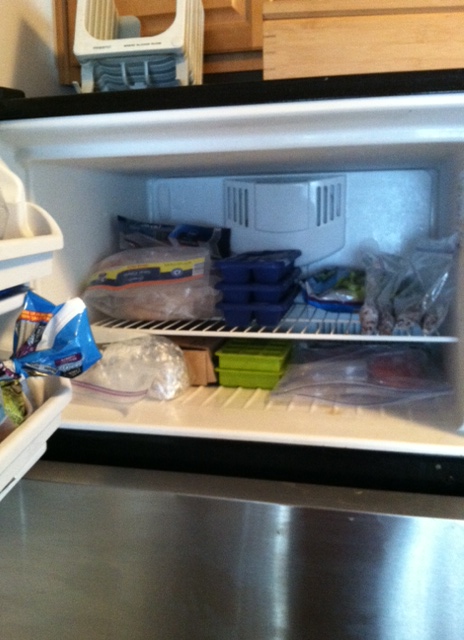
First up we have my freezer:

image (15)

I buy big bags of frozen fish (top left corner) from Aldi.  This saves money and time because it is so easy to grab a piece of tilapia or salmon, season it, put it in a baking dish, cover and bake for 20 or so minutes. Remember, you don’t need to get all fancy for your week night meals. I also have frozen veggies, that I steam for quick sides.  I also have individual bags of beans that have been cooked and frozen (top right corner).  These are so simple to throw into any dish, from soups to scrambles to salads, and they are so easy to make in your crockpot.  There are also some frozen pork chops that I make for dinner for Adam some nights (bottom left corner) and frozen homemade bread for Adam’s breakfast toast (bottom left corner).

Next up, my fridge:

image (14)Starting with the top we have a lot of eggs. We use eggs for breakfast, dinner, and snacks.  We hard cook them, scramble them, turn them into omelettes or frittatas, poach them, pretty much any way you can eat/cook an egg we have done.  Eggs are relatively cheap and they make healthy, quick meals!  Moving on down to the next shelf we have parsnips and carrots that will be used for lunches and dinners and next to that we have those beautiful leftovers I mentioned earlier!  On the bottom shelf and in the drawers we have more fruits and veggies (like broccoli, cabbage, beets, turnips, and pears) that will be used for lunches and sides for dinners. My go to method for veggies is to cut them up and then come dinner time throw them on a foil covered pan, drizzle some olive or coconut oil, season with whatever strikes my fancy, and roast them at 400 for 20-35 minutes.  Simple, quick, and delicious.  Also on the bottom shelf we have water (a must no matter what), almond milk for my breakfasts/baking purposes, veggie broth, oj, and hidden back there are some beers for Adam.  A guy’s gotta have his brew!  On the door, where you can’t really see, I have a variety of condiments such as mustard, homemade ketchup, hot sauce, salsa, jams, and other various things that can be thrown into recipes to make things taste delicious!

A quick glance at my spice cabinet:

image (17)

I’m not going to name every single spice in my cabinet, because quite frankly I am a spice junky and have probably hundreds of spices!  I have talked before about how important spices are to healthy eating because they are such a great way to season your food without adding unnecessary chemicals/calories to your meal.  Start experimenting and find out what your favorite tastes are and once you figure that out you can even start making your own spice blends, like a taco or pizza seasoning!

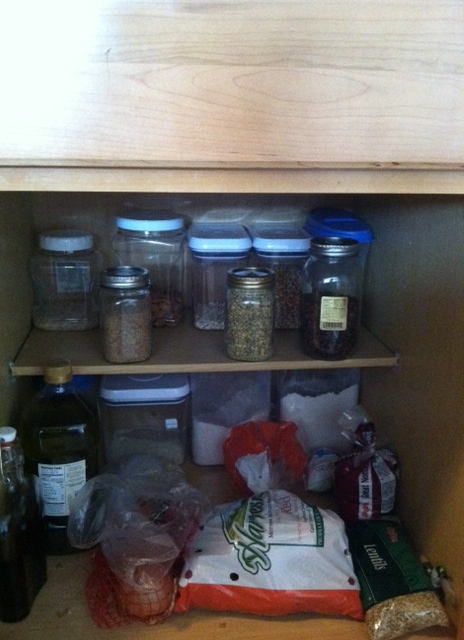
And finally my cupboard/pantry:

image (18)

image (19)In the top picture we have all my grains and flours.  I use everything from brown rice to quinoa to lentils to steel cut oats.  I also have almond flour (for gluten free baking), whole wheat flour and whole wheat pastry flour.  I also have raw almonds for snacks, onions and potatoes for meals, ground flax seed for baking, and various dried beans to be cooked.  In the bottom picture we have mostly canned goods and stockpiled stuff like soups, peanut butter (a MUST in this household), loose leaf teas and various other baking supplies.  Usually when there is a good sale on say pumpkin or diced tomatoes (fire roasted and no salt added are my favorite), I will stock up.  This makes it easy to have them on hand to throw into any meal.

Now this is by no means all the food we have in the house any given week.  We also have various other fruits and vegetables that are kept in different areas.  Hopefully the pictures helped give you an idea of how of how to stock your own kitchen and some of the tips I use gave you some ideas of how to prep your own healthy eating lifestyle.  Eating better does not have to be stressful as long as you just take some time to plan it out and stick to simple techniques.  The easy act of just cutting up some carrots for lunches or adding an extra chicken breast for dinner to make leftovers can make a world of difference in eating better! So give a few of these tips a try and see how easy and beneficial it really is!  If you already do your own prep day and have some tips/advice of your own, feel free to share with everyone!  The more we talk with each other and share our healthy ideas the easier it is to change the way we eat and live!

Have a fabulous week and I’ll see you next Monday with a post about some of the meals Adam and I eat throughout the week!

My Digestive Journey- Probiotics

Last week I talked about eliminating certain things from your diet in order to help heal your gut.  For me personally that meant getting rid of dairy as well as gluten.  This week I want to talk about adding something to your diet: probiotics.

Little Biology lesson for you:  You have bacteria and microbes all over your body, from your skin, to your eyelashes, to inside your digestive system.  Before you freak out and douse your body with sanitizer, these are good bacteria and essential to your every day functions.  These bacteria have various jobs, but the ones in your gut help to digest your food.  A healthy gut can have upwards of trillions of microbes helping to breakdown your food so you can use it to function.

When you don’t have a healthy gut, your microbe count can drop way down.  This in turn affects your digestion.  You no longer have a billion little helpers and food can sit in your digestive tract and rot or pass through only partially digested.  Clearly having rotting food sit in your gut is not an ideal situation.  This can lead to stomach problems, bloating, gas, and just general unpleasantness.  Many things contribute to unhealthy microbes.  Taking anti-biotics can damage good bacteria as well as bad bacteria, as well as eating an unhealthy diet.

This is where probiotics come in.  Adding probiotics to your diet can help restore and repair the bacteria in your gut, in turn helping your body to properly digest and use the food you eat.  There are plenty of ways to get probiotics into your diet and I’ve tried a few here on this list. REMEMBER: I’m not a doctor or any type of certified medical professional.  This is just a list that I have made based on my own research.  Talk with your health care professional if you want to start adding more of these to your life.

Probiotic Pills There are a plethora of probiotic pills out there on the market.  It can be overwhelming to try and find the right one for you.  While I’m a believer in trying to get your nutrients/vitamins/minerals from food, I realize it’s difficult to get everything you need every day from food alone. When looking for probiotics you don’t need anything fancy, just probiotics.  Here is a list, by all means not all inclusive, of different probiotics and their functions.  Start here and go through and find the function that you need and then work from there.  Look for pills that contain that strand of bacteria.  Talking to your doctor or a nutritionist can also help as they are well equipped to help you sort through all the information out there.

Some forms of dairy  This one I approach with caution.  Obviously I do not eat any dairy, but there are products, such as yogurt, that have probiotics in them..  The downside is that many times they will also have added sugar and chemicals that don’t help your digestion.  So be careful if you choose this approach.  Plain Greek yogurt is a good start and you can add in your own flavoring such as honey or fruit.

Fermented Foods Tempeh, kimchi, kombucha.  All of these are fermented food/drinks.  Because of the fermentation process, these products have probiotics that can help with digestion.  This is the route that I have been experimenting with lately and it has given me some great results.  While these foods may sound weird and not as appetizing as, say, a plate of cookies, they really taste good and are immensely helpful.  I have mentioned kombucha before and this is the fermented food that I have used the most. Kombucha is a type of fermented tea that you can purchase at most grocery stores.  Unfortunately it is pretty expensive (around $4 for us here in the Midwest  but the good news is that you can actually make your own!  I recently purchased my own kombucha kit, and while I haven’t started to grow it yet (I’m going to wait until after we move in April), it is actually a fairly simple process and not at all intimidating.  Plus once you start to grow your own kombucha you can have a never ending supply because it just continues to grow, as long as you maintain it.  Once I get kombucha down I plan to start trying to make my own fermented vegetables.  I’ll try to share that process with you as I go through it so that you can reap all the benefits of fermented food!

This is by no means a complete list of probiotic help.  There are other things such as papaya and apple cider vinegar that also have probiotic qualities and will help with your digestion.  Again, the key here is finding a method that works best for you.  Perhaps you can’t stomach the idea of eating billions of microbes (don’t worry, it is a little creepy at first) and want the convenience of a pill.  That’s totally fine, this isn’t about following the crowd and choosing what is most popular at the time. This is about finding the combination of digestive aids that works for you and gives you the best results.

Hopefully these last few posts and some of the advice have been helpful to you.  I would love to hear from you readers with any questions, comments, and/or concerns.  I write this blog to help you and your input is greatly appreciated!  Have a great Monday and an awesome week!